REVIEW · TESTED APRIL 2026
The Contractor Quoted $1,800. We Did It Ourselves on a Saturday for $249. Here's the Honest Result.
Three contractor quotes. A $249 kit. A thermal camera aimed at a 1970s rim joist before and after. Here's exactly what changed — and what didn't.
How we tested
We applied BEEST FULLSTOP to the full rim joist perimeter of a 1,200 sq ft 1970s ranch-style home in Pennsylvania — approximately 230 linear feet of rim joist area. Before application, we measured surface temperatures at 10 points along the rim joist using a Fluke ii910 FLIR thermal camera with a 60°F ambient basement temperature. We applied two passes following manufacturer instructions: a 1-inch first coat, 30-minute wait, then a second pass to reach approximately 1.5 to 2 inches total depth. We used 11 of the 12 included cans. Thermal measurements were repeated at 72 hours post-cure at the same 10 points. We also checked adhesion at 10 and 30 days. Three local spray foam contractors were contacted for quotes before testing began.
The rim joist — the band of lumber sitting atop your foundation wall — is one of the single leakiest spots in a 1970s home. Cold air pours through gaps around joists, pipes, and the sill plate. The floor above feels cold, the heating system works harder, and every dollar of heat you pay for has a small, constant exit route along the entire perimeter of the house.
We called three local spray foam contractors. Quotes came back at $1,800, $2,100, and $2,400, all with 3 to 4 week lead times and a minimum job size that meant we were being charged for more foam than we needed. One contractor required a second visit for the second coat. The math pointed toward the $249 kit.
Why we called contractors first
Most homeowners never get past the first contractor quote. The numbers are usually high enough that the project gets shelved, and the rim joist stays uninsulated for another winter. We wanted to know whether DIY closed-cell spray foam — the kind of product that's marketed at $249 with a metal gun and PPE — actually delivers the same result as a professional installation.
Three contractors. Three quotes between $1,800 and $2,400. Three lead times of 3 to 4 weeks. The contractors are not overcharging — spray foam labor is genuinely involved, the rig is expensive to bring out, and minimum job sizes exist for a reason. But for a small-perimeter basement that needs maybe 200 sq ft of foam, the per-square-foot economics of a professional install break down. The kit is the right tool for the right job size.
What's in the box
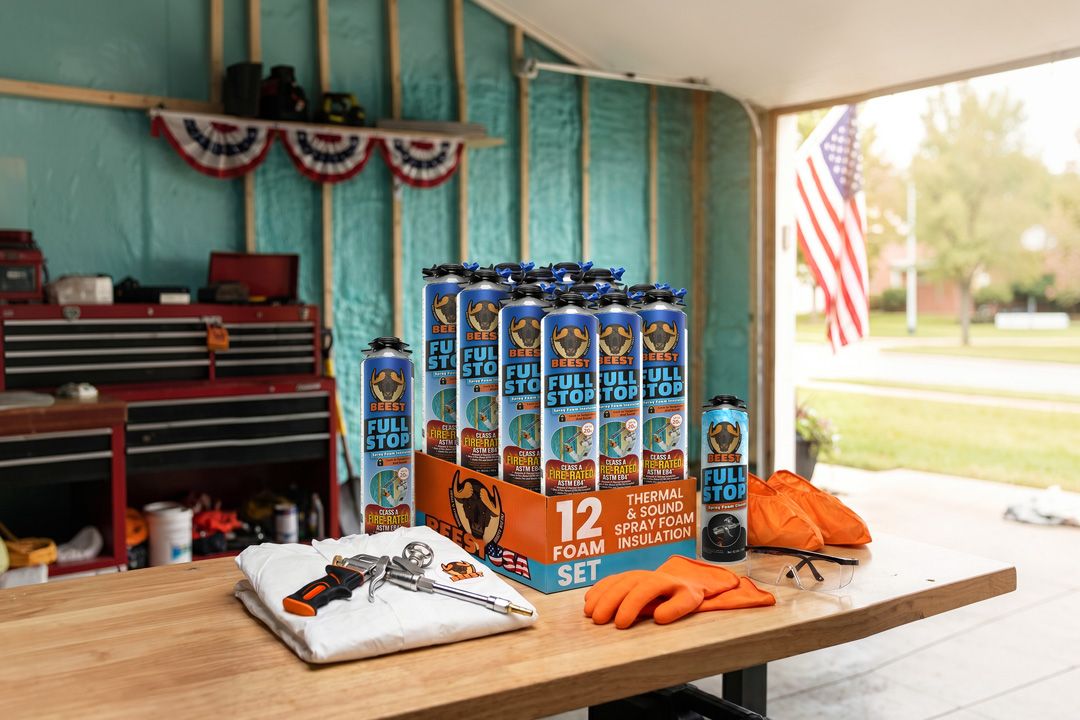
The BEEST FULLSTOP kit ships as a complete system. Nothing else needed from the hardware store.
- 12 spray foam cans. One-component moisture-cured polyurethane. Wide-pattern coverage nozzles included for wall and ceiling application.
- BEEST Pro-X metal gun. 30-degree rotating barrel for tight corners. Rear flow-control knob. Ergonomic aluminum body. Extension tubes and conical tips included.
- Foam cleaner (500 ml). Solvent-based aerosol for uncured foam. Clears the gun after use, dissolves overspray. Four-year shelf life.
- Full PPE package. Nitrile gloves, safety goggles, and a full-body coverall. No separate purchases needed — the kit is genuinely complete.
- Step-by-step guide. Detailed written instructions covering surface prep, application technique, layering, and cleanup.
- Video Vault masterclass. QR code in the kit links to full video walkthroughs for rim joists, basements, van insulation, shed conversions, and more.
Application — what actually happens
Gun assembly took about three minutes. Attaching the first can, priming the trigger, and getting a steady bead took another 45 seconds. The foam comes out amber-yellow, expands immediately on contact, and bonds to the substrate before you've moved the gun six inches.
We applied the first coat in horizontal passes across the rim joist, working from left to right along each bay. The 30-degree rotating barrel on the Pro-X is genuinely useful here — the angled tip lets you reach into joist bays and behind pipes without contorting. One inch of coverage per pass is the standard, and the flow-control knob on the rear of the gun lets you meter output precisely enough to hit that without pooling.
After a 30-minute wait, we applied a second pass for depth. Total application time for 228 sq ft of rim joist: 3 hours 40 minutes including setup and cleanup. The basement smelled of fresh foam for the rest of the day. Ventilation was running throughout, and we kept the space closed to occupants for the full 72-hour cure window.
The vapor question — what this foam is and isn't
BEEST FULLSTOP is a vapor resister, not a full vapor barrier. It slows moisture movement through the rim joist area without fully blocking vapor transmission — which is actually appropriate for most above-grade rim joist applications, where you want some drying potential.
Test results
1. Coverage accuracy — accurate
The kit claims approximately 240 sq ft at 1 inch thickness. We applied 11 of 12 cans at an average depth of approximately 1.5 inches and covered 228 sq ft of rim joist. The extra depth reduced our total square footage versus the spec sheet — a direct trade-off. One unused can remained for touch-up work.
| Cans used | 11 of 12 |
| Area covered | 228 sq ft |
| Average depth | ~1.5 inches |
| Spec claim | 240 sq ft at 1 inch |
2. Gun performance — passed, zero clogs
The Pro-X metal gun ran through all 11 cans over 3 hours 40 minutes without a single clog, hesitation, or uneven bead. We swapped cans 10 times during the application. The aluminum body showed no heat buildup, and the trigger mechanism stayed smooth throughout. We cleaned the gun with the included cleaner immediately after the final can. Total cleanup time: 6 minutes.
| Clog events | 0 |
| Can swaps | 10 |
| Total run time | 3 hr 40 min |
| Cleanup time | 6 minutes |
3. Thermal performance — significant improvement
Before application, with 60°F ambient basement temperature, we measured surface temperatures at 10 points along the rim joist. Average: 41°F — clear evidence of cold air infiltration at the rim joist interface. At 72 hours post-cure, we measured the same 10 points. Average: 53°F, a 12-degree improvement. The foam had eliminated the direct cold-surface contact zone at the joist-to-foundation interface.
| Before (avg) | 41°F surface temperature |
| After (avg) | 53°F surface temperature |
| Improvement | +12°F |
| Ambient basement temp | 60°F |
4. Adhesion durability — fully bonded at 30 days
At 10 days and 30 days post-application, we checked adhesion at 15 points across the treated surface — wood sill plate, concrete block foundation, and a metal cross-brace section. Zero delamination observed at any point. The foam remained flush and bonded across all three substrate types.
| Substrates tested | Wood, concrete block, metal |
| Delamination at 10 days | None |
| Delamination at 30 days | None |
Three contractors quoted between $1,800 and $2,400 for the same job. The kit cost $249 and took one Saturday. That's not a close call for anyone comfortable with basic DIY work.
Pros and cons
Pros
- Saves $1,000 to $3,750 versus professional spray foam installation
- Truly complete kit — nothing else needed from the hardware store
- Pro-X metal gun: zero clogs over 11 cans in our test
- +12°F thermal improvement confirmed with FLIR camera
- Adheres to wood, concrete, metal, glass, brick, drywall, OSB
- Air seals and insulates in one step — fiberglass cannot
- 80 to 100 year lifespan — no settling, slumping, or degradation
- Phone support that answers and actually helps troubleshoot
Cons
- 24 to 72 hour cure window — space must be vacated and ventilated
- Vapor resister only — wet basements need poly sheeting first
- Cans need to be at 68°F or warmer — requires warm storage or pre-warming
- Cured foam is permanent — mask off anything you don't want coated
- Vented attics require special consideration — don't seal the vents
- Not for areas with standing water or direct water infiltration
Who this is for
Specs at a glance
| Kit contents | 12 spray foam cans, Pro-X metal gun, foam cleaner (500 ml), gloves, goggles, coverall, instructions, Video Vault QR code |
| Kit coverage | ~240 sq ft at 1 inch thickness (tested: 228 sq ft at ~1.5 inches) |
| Formulation | Blended cell polyurethane — one-component, moisture-cured. Open and closed-cell characteristics. |
| R-value | R-4.12 at 1″ · R-8.24 at 2″ · R-12.36 at 3″ · R-16.48 at 4″ · R-20.60 at 5″ |
| Expansion ratio | 100 percent — 0.5″ wet expands to 1″ cured |
| Application temp | Surface and air min 41°F · Cans must be 68°F or warmer for proper expansion |
| Cure time | 24 to 72 hours before reoccupying. Ventilate throughout. |
| Cured temp range | −22°F to 176°F (−30°C to +80°C) |
| Adhesion | Wood, concrete, metal, glass, brick, drywall, OSB, and more |
| Vapor control | Vapor resister, NOT a full vapor barrier. Slows moisture movement. |
| Propellant | Ozone-safe |
| Paintable | Yes, after cure. Outdoors: protect from UV with paint or coating. |
| Lifespan | 80 to 100 years — no settling, slumping, or R-value loss |
| Pro-X gun barrel | 30-degree rotating swivel for tight corners and joist bays |
| Made in | Manufactured in Turkey · American-owned family company, Carlisle, Pennsylvania |
Final verdict
The BEEST FULLSTOP kit did what it claimed. The coverage was accurate, the Pro-X metal gun ran clean for over three hours without a clog, and the thermal camera showed a real, measurable improvement at the rim joist — not a marginal number, but 12 degrees warmer surface temperatures at one of a home's single leakiest seams.
The savings math is the part that stops you mid-sentence. Three contractors quoted $1,800 to $2,400 for the same job. The kit cost $249 and took one Saturday. That's not a close call for anyone comfortable with basic DIY work. The included video tutorials, step-by-step guide, and phone support ensure you're not on your own if something unexpected comes up.
Know the limits before you start: it's a vapor resister, not a full vapor barrier, so wet basements need poly sheeting first. Warm the cans. Ventilate the space. Clean the gun immediately. Follow those four rules and you'll finish the job in an afternoon and wonder why you waited so long to call three contractors.

The DIY kit that delivers what professional contractors quote $1,800+ for. Pro-X metal gun runs zero clogs across 11 cans. FLIR-verified +12°F thermal improvement. Complete with PPE, foam cleaner, and Video Vault tutorials.
Warm the cans. Ventilate the space. Apply two passes. Clean the gun immediately. That's the recipe.