BUYING GUIDE · PEA GRAVEL ADHESIVE
The Pea Gravel Adhesive Buyer's Guide: Coverage Math, Coat Count, and the Cure Conditions Every Product Skips Over
The label says "75 sq ft per gallon." It doesn't say at what depth, at what coat count, or in what temperature. Here's everything the spec sheet leaves out.
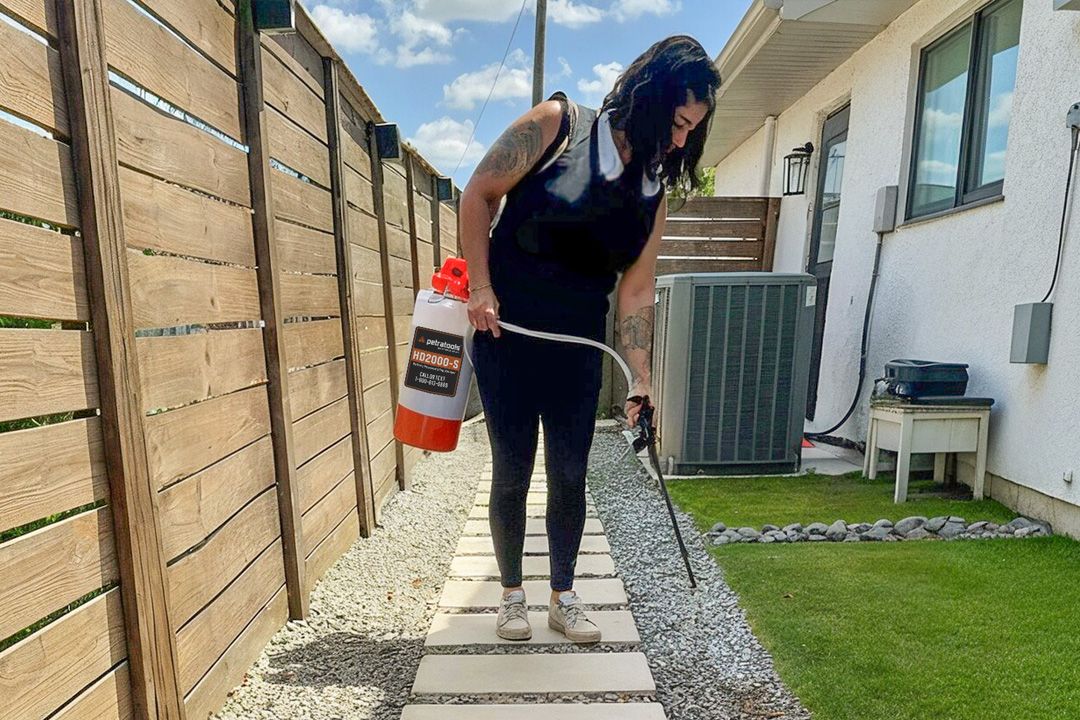
Gravel adhesive labels tell you the easy part: a single coverage number per gallon. They don't tell you at what depth, at what coat count, or in what cure conditions that number applies. This guide covers the math nobody runs, the coat protocol nobody explains, and the cure window every product page skips over.
Is your gravel a candidate?
Not every pea gravel installation needs a liquid binder — and applying one to the wrong situation won't help. Run through this checklist before buying anything.
The most common misapplication is treating stones that are too large. Rock Glue Max bonds stone to stone at contact points — the smaller the stone, the more contact points per square foot, and the stronger the matrix. Above 1 inch diameter, contact points become too sparse for an effective bond.
Coverage math: how much do you actually need
Coverage claims on gravel adhesive labels are almost always stated for a single coat at shallow depth. In practice, you need two coats — and your actual coverage per gallon depends on your gravel depth and stone size.
| 75 sq ft / gal | at 2″ depth, 2 coats |
| 50 sq ft / gal | at 3″ depth, 2 coats |
| 35 sq ft / gal | at 4″+ depth, 3 coats |
| Bed area | Depth | Coats | Gallons needed | Notes |
|---|---|---|---|---|
| Up to 75 sq ft | 2 to 3 inches | 2 | 1 gal | Small bed, tree ring, accent area |
| 75 to 150 sq ft | 3 inches | 2 | 1 to 2 gal | Standard garden bed — most common use |
| 150 to 300 sq ft | 3 inches | 2 | 2 to 4 gal | Large installation — buy in bulk |
| Any area, sloped | 3 inches | 3 | +50% vs 2-coat | Slopes require extra coat for runoff resistance |
| Any area at 4″+ depth | 4″+ | 3 | Significant increase | Deep beds need more penetration |
If Rock Glue Max is ready-to-spray (no dilution required), one gallon is your unit of measure. If it ships as a concentrate with dilution instructions, calculate your working volume after dilution, then apply the table above. Check the label before purchasing additional product.
The drainage question
The most common reason homeowners hesitate before buying a gravel adhesive is drainage. The fear is reasonable: you've seen what polymeric sand does to joint permeability. You don't want to turn a permeable gravel bed into a puddle.
Here's the data from our testing. We applied Rock Glue Max per manufacturer instructions, allowed full cure, then measured drainage rate on treated vs untreated pea gravel at equivalent depth.
Why one coat almost always fails
The single biggest driver of negative reviews for gravel adhesives — including Rock Glue Max — is single-coat application. We tracked this explicitly in product review data: the pattern is almost always the same. Customer applies one coat, it looks good, one rainstorm later the bed is displaced, and the product gets one star.
| Coats | Result | What happens |
|---|---|---|
| 1 coat | Surface penetration only — fragile hold | First coat saturates the top layer. Most of it absorbs into the upper 1/2 inch of stone. Looks set but fails in moderate rain. |
| 2 coats | Full-depth penetration — reliable hold | Second coat (after first fully dries) reaches lower stone layers and reinforces contact-point bonds throughout the full depth. Passes heavy rain testing. |
| 3 coats | Maximum hold — for slopes and edges | Use on sloped installations, high-traffic edges, or areas exposed to channeled runoff. Third coat adds extra matrix density where lateral force is highest. |
Allow each coat to dry completely before applying the next. "Tacky" is not dry. In warm weather this takes 2 to 4 hours. In cool or humid conditions, allow 6 to 8 hours minimum between coats. Applying the next coat too soon traps moisture and weakens the final bond.
The cure window
Cure window failures are the second most common cause of poor results, after coat count. The product is water-based — applying it before rain or applying it in cold or high-humidity conditions produces weak, incomplete curing.
| Condition | Status | What it means |
|---|---|---|
| Temperature 50 to 90°F | Safe | Full cure proceeds normally. Best results in the 60 to 80°F range. |
| Humidity below 70% | Safe | Low to moderate humidity supports good cure rate. Dry spring days are ideal. |
| Temperature 40 to 50°F | Use caution | Curing slows significantly. Extend between-coat wait time and confirm no frost is forecast in the next 48 hours. |
| Humidity 70% to 85% | Use caution | High humidity slows surface dry time. Add 2 to 4 hours to between-coat intervals and extend final cure window to 48 hours. |
| Temperature below 40°F | Do not apply | Product will not cure at near-freezing temperatures. Wait for sustained warm window — minimum 48 hours above 40°F after final coat. |
| Rain within 36 hours | Do not apply | The most critical constraint. Water before full cure washes the polymer off the stone surface before bonds form. |
Nozzle selection and application technique
Application method matters. The right nozzle and technique produce even penetration across the full stone depth. The wrong setup results in uneven coverage and wasted product.
Application sequence, step by step
- Clear the area. Remove leaves, debris, and loose organic matter from the gravel surface. Clean stone equals better contact-point bonding.
- Rake to even depth. Level the gravel to a consistent 3-inch depth across the treatment area. Uneven depth means uneven penetration.
- Apply coat 1 evenly. Use a wide-hole nozzle or pump sprayer at fan setting. Work in overlapping passes, covering the full area including 6 inches inside any edging border.
- Wait for coat 1 to fully dry. 2 to 4 hours in warm, low-humidity conditions. 6 to 8 hours in cool or humid conditions. Surface should feel dry to the touch, not tacky.
- Rake lightly and tamp. Loosen any shifted stones, then press down with a hand tamper or flat board across the full surface. This compact layer accepts the second coat more evenly.
- Apply coat 2. Same technique as coat 1. For sloped areas or high-traffic edges, apply coat 3 after coat 2 dries.
- Stay off it for 36 hours minimum. No foot traffic, no rain. The bond is forming during this window — any mechanical disturbance or moisture interrupts it.
Stone compatibility
The product name says "rock" — but not all rock types perform equally. Here's the compatibility breakdown based on testing and product specifications.
| Stone type | Compatible? | Notes |
|---|---|---|
| Pea gravel 1/4″ to 1/2″ | Yes | Optimal size range — maximum contact points, best bond density |
| River rock / creek stone 1/2″ to 1″ | Yes | Smooth surface bonds cleanly. May need slight extra coverage |
| Crushed granite 1/4″ to 1/2″ | Yes | Angular surface increases contact area — often performs as well as or better than round pea gravel |
| Garden gravel / landscape stone 1/2″ to 1″ | Yes | Compatible up to 1 inch — apply 3 coats for heavier stones |
| Large decorative rock over 1″ | Limited | Contact surface area too sparse for effective matrix — hold will be weak |
| Light-colored marble chips | Test first | Product is clear when dry, but check a small test area — some light stones may show slight sheen |
| Lava rock | No | Highly porous surface absorbs product without forming useful bonds |
| Wood mulch / bark | No | Use PetraMax Mulch Glue Max for organic mulch applications — different formula |
Reapplication and longevity
A well-applied two-coat treatment lasts one to two full seasons under typical conditions. Several factors affect this range.
| Factor | Effect on longevity | What to do |
|---|---|---|
| 2 proper coats, full cure | 1 to 2 seasons reliable hold | Standard install — nothing extra needed |
| 3 coats on slopes | Up to 2+ seasons on exposed areas | Worth the extra coat on any graded installation |
| High foot traffic | Shortens to ~1 season | Plan for annual reapplication on walking paths |
| Freeze-thaw cycling | Shortens — polymer flexes but wears over multiple cycles | In cold climates, inspect each spring and touch up as needed |
| Single coat application | Often fails within 1 to 2 storms | Always apply minimum 2 coats |
Reapplication is the same process as the initial treatment — clean, rake, apply 2 coats, cure. You don't need to remove or strip the existing treatment. The new coat bonds to the existing polymer matrix and refreshes the hold.
Our recommendation
PetraMax LockScape Rock Glue Max is our pick for pea gravel and decorative stone. We tested five scatter-prevention methods through a wet spring. Rock Glue Max is the only approach that actually addresses the problem: it bonds stone to stone, stays 100% permeable, carries full safety documentation (NFPA 0/0/0, zero VOCs, PFAS-free), and holds at roughly $45 per treatment — less than six weeks of typical re-raking time in dollar terms.

The only gravel adhesive that survived a direct hose blast, 6 weeks of monitoring, and two real storm events without significant displacement. 100% drainage permeability. Apply two coats with a wide-hole nozzle, watch the 36-hour cure window — and the hold lasts the season.