Feature · Landscaping
Why Your Mulch Keeps Washing Away — And Why Most Homeowners Never Solve It
The displacement problem has existed as long as decorative mulch has. The solution has existed for years. Here's why almost nobody uses it.
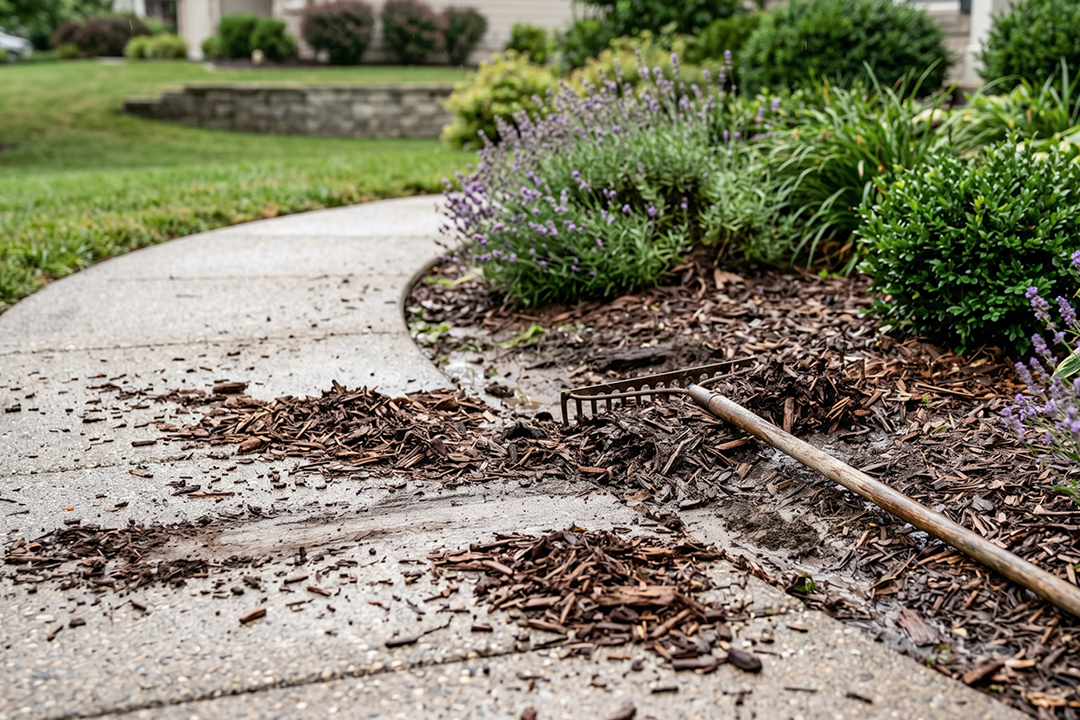
Every spring, the same thing happens. You pay to have your mulch beds freshly laid or you lay them yourself, and they look exactly right for about a week. Then it rains. The mulch migrates into the grass along the bed edge, accumulates in low spots, scatters down the driveway, and thins out in the middle where the rain hit hardest. You rake it back. Three weeks later, same thing. If you've owned a house with decorative mulch for more than a year, you already know this pattern well enough that it barely registers as a problem anymore. You've just accepted it as part of owning a yard.
That acceptance is the thing I find most interesting about this category.
The problem everyone has accepted as permanent
Mulch displacement is one of those maintenance problems that sits just below the threshold of action. It's annoying enough to complain about and not annoying enough to solve — at least not in any systematic way. Most homeowners respond to it reactively: they rake after major rain events, add a bag of fresh mulch once a year to compensate for what's been lost, and consider the matter managed.
Landscapers know this pattern intimately. The re-spreading visit is one of the most reliably recurring line items in residential landscape maintenance budgets. At $200 or more per visit, and two to four visits a year for properties with significant mulched areas, it adds up to a real number very quickly. Most homeowners pay it without fully registering that they're paying for the same labor, on the same beds, producing the same temporary result, year after year.
The reason this continues isn't that no solution exists. A category of products — water-based landscape adhesives designed specifically to bind mulch, wood chips, bark, and pine straw in place — has existed for years and performs genuinely well when applied correctly. The reason is awareness, and a second thing that's harder to name: a persistent skepticism that something this simple could actually work.
Why everything you've already tried didn't work
Before landscape adhesives, homeowners tried a range of partial solutions. Edging — the physical barrier between bed and lawn — addresses lateral migration but does nothing about rain-driven redistribution within the bed or wind displacement over the top. Landscape fabric suppresses weeds but doesn't hold the mulch sitting on top of it. Heavier mulch types (rubber mulch, large bark nuggets) displace less readily than fine wood chips, but they still move in significant rain events and they cost more per square foot.
The most common DIY attempt — Elmer's glue or PVA diluted in water — fails for a simple chemical reason: PVA is water-soluble even after drying. The same rain that moves untreated mulch will dissolve the glue holding it. You're not actually creating a rain-resistant bond; you're creating a temporary one that fails the first time it's tested.
The reason mulch keeps washing away isn't physics. It's that most people have never heard of a product that actually fixes it.
Purpose-built mulch adhesives — the polymer-emulsion formulas engineered for outdoor UV resistance, water permeability, and multi-season durability — solve the problems that the DIY alternatives don't. They coat individual mulch pieces with a permeable film that holds them together while allowing water and nutrients to drain through freely. They're designed to cure in place, resist freeze-thaw cycles, and not block the soil biology underneath. They are, by any reasonable definition, the correct technical solution to the displacement problem.
The catch is that they require a specific application protocol to work. One coat doesn't produce a durable bond — three coats do. The treated area needs 12 to 36 hours of dry weather after the final coat to cure completely. A fine-mist nozzle will clog the sprayer; a cone or flat spray pattern won't. These aren't complicated requirements. But they're specific enough that first-time users who skip the instructions often get poor results, write a negative review, and conclude the entire product category is a scam.
The math that should be obvious but isn't
There's a straightforward economic argument here that most homeowners have never run because they've never thought of mulch displacement as a solvable problem — only a manageable one.
A one-gallon bottle of a quality mulch adhesive (Ready-to-Spray formula) covers 50 square feet at the recommended three-coat application. A typical front-yard property with two to three mulch beds totaling 150 to 200 square feet would need three to four gallons — a total investment in the range of $80 to $120 for the initial application. Reapplication every 6 to 12 months brings the annual cost to somewhere between $40 and $120 per year depending on bed size and how often you touch up.
Compare that to the alternative: $200 per landscaper re-spread visit, two to four times per year, plus the time you spend raking yourself between visits. By any reasonable accounting, the adhesive route is an order of magnitude cheaper. And yet the industry for professional mulch re-spreading continues to be one of the most reliable recurring revenue streams in residential landscaping. The math hasn't moved behavior because the alternative hasn't been visible enough to prompt the calculation.
Part of this is a marketing failure by the manufacturers. Products in this category have historically been sold and positioned toward landscaping professionals rather than homeowners. The consumer-facing branding and education around when and why to use these products has been sparse. A homeowner standing in the lawn-and-garden aisle at a big-box store is unlikely to encounter a mulch adhesive at all, much less a clear explanation of what problem it solves and how to use it correctly.
What changes when you actually test it
We spent April testing four mulch adhesive products on identical garden beds. Hose blasts, leaf blower, passive monitoring through three real rainstorms. The results were clear enough that they shifted how we think about this category — not as a niche product for landscaping contractors, but as a standard homeowner maintenance tool that most people with mulch beds should be using.
The product that stood out — PetraMax LockScape Mulch Glue Max — held through every test we ran. More interestingly, it backed every safety claim with filed regulatory data: NFPA Health rating of 0, zero VOCs confirmed by third-party lab testing, no PFAS, no forever chemicals. The drainage concern that comes up constantly in customer conversations (nearly 1,000 mentions in the company's own data) turned out to be a legitimate mental model problem rather than an actual product limitation. We poured five gallons through the treated area. It drained identically to untreated mulch alongside it. The word "glue" triggers the wrong mental model. This isn't contact cement. It's a permeable polymer binder.
What struck me most, reviewing the customer objection data, is how many of the concerns people have about this product type are legitimate and reasonable — and how completely the product addresses them once you look at the actual specs. Worried about toxicity near your kids and dog? NFPA Health = 0 is the same rating as water. Worried about drainage? 100% permeable, tested. Worried it's too good to be true? We ran a 30-day test in real conditions. It held. The skepticism is rational. The outcome, when applied correctly, is real.
The displacement problem isn't going away on its own. Rain will keep falling, wind will keep blowing, and mulch will keep migrating until something holds it in place. That something has existed for years. The main thing standing between most homeowners and a maintained-looking landscape that doesn't require re-raking every month isn't the product — it's awareness of it, and the three coats of patience required to make it work.
The product we recommend
PetraMax LockScape Mulch Glue Max held through every test we ran. Water-based, pet-safe, 100% permeable, Made in USA. For application instructions and dilution ratios, see our full buyer's guide.

Water-based polymer emulsion, pet safe (NFPA Health = 0), zero VOCs, PFAS-free, Made in USA. Three coats with a 36-hour dry cure window. The displacement problem that's been around for decades finally has a permanent fix, and it costs less than one landscaper re-spread visit.